Talk To Anthony - Call (951) 202-2303

What September’s Mortgage Rate Plateau Means for Buyers and Sellers

If your phone has been a little quieter than usual this year, there’s a reason. Mortgage rates have spent much of 2026 recovering from February’s brief decline before settling into a persistent mid-6% range, and the latest data suggests that pattern is continuing.
As of September 3, 2026, Freddie Mac reported the average 30-year fixed mortgage rate at 6.71%, up slightly from 6.66% the previous week and roughly 20 basis points higher than a year ago. The 15-year fixed rate stands at 6.04%. Other major surveys are telling a similar story, with Bankrate reporting 6.76%, Zillow 6.69%, and the Mortgage Bankers Association’s weekly index at 6.79%.
For real estate agents, the takeaway isn’t that high rates are crashing the market. It’s that rates appear to have reached a ceiling, and that distinction matters.
Many buyers who were advised to wait for rates to fall a year ago are still waiting, and current data suggests they may be waiting for some time. For agents, that creates an opportunity. Clients who understand where the market actually is—not where they hoped it would be—are often better equipped to make timely decisions and negotiate with realistic expectations.
Here’s what is driving the current rate plateau, what it means for buyers and sellers today, and how you can discuss it during your next listing appointment or buyer consultation.
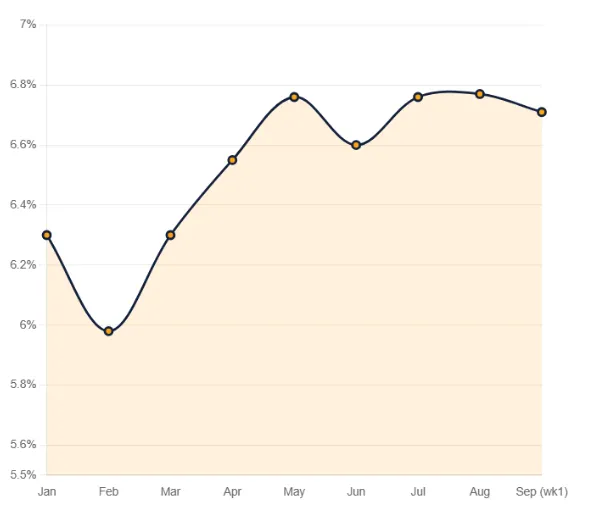
The 2026 Story in One Chart
Mortgage rates began the year in the low-6% range, continuing the gradual downward trend that had led many forecasters, including the MBA and NAR, to predict an average rate in the mid-6% range for 2026.
For the first several weeks of the year, that outlook appeared accurate. Rates even reached a yearly low of approximately 5.98% in February.
Then conditions changed quickly.
Escalating conflict in the Middle East, followed by U.S. and Israeli strikes against Iran in late February, pushed oil prices and inflation expectations higher almost overnight. Because mortgage rates tend to move alongside the 10-year Treasury yield, and Treasury yields are heavily influenced by inflation expectations, the impact reached mortgage pricing within weeks.
Between March and May, rates climbed by approximately 50 to 70 basis points, briefly reaching the mid-to-upper 6.7% range in early May.
A ceasefire in June provided buyers with a short period of relief as rates temporarily declined. However, renewed fighting later in the summer erased those gains, and by mid-July, the average 30-year rate had once again moved above 6.75%.
Since then, mortgage rates have largely moved sideways, staying within a narrow range of roughly 6.65% to 6.80% for nearly three consecutive months.
That stability is the real story heading into September. After a volatile spring, the mortgage market appears to have reached a plateau.
Why Rates Aren’t Falling — the Short Version
Three major factors are currently keeping mortgage rates elevated. Understanding them can help you give clients a more informed answer when they ask, “When are rates finally going to come down?”
-> Inflation remains above the Fed’s target. The Federal Reserve’s 2% inflation goal has yet to be reached, and Fed Chair Kevin Warsh has publicly described persistent inflation as concerning. Continued inflation pressure tends to keep bond yields—and therefore mortgage rates—higher.
-> The Fed is holding steady rather than cutting. The central bank kept its policy rate unchanged during its January, March, April, June, and July meetings this year. Several committee members even voted in favor of a rate increase in July. Markets are now pricing in a genuine possibility of another rate hike, rather than a cut, at the September 15–16 meeting.
-> Geopolitical uncertainty continues to influence inflation expectations. Oil prices moving above $92 per barrel after OPEC+ indicated it would maintain production cuts, combined with ongoing tensions in the Middle East, continue to add inflation risk that bond markets must account for.
Taken together, these factors have led many major forecasters—including Fannie Mae, the MBA, and LendingTree—to expect the average 30-year mortgage rate to remain in the 6.3% to 6.7% range through the remainder of 2026.
A return to rates near 5% is currently viewed as highly unlikely in the near term.
What This Means for Buyers
Many buyers have spent much of 2026 waiting for conditions to improve. Ironically, the current rate plateau may be exactly what encourages them to move forward—if the situation is framed properly.
-> Affordability hasn’t improved dramatically, but it has become more predictable. A mortgage rate that remains stable for several months gives buyers more confidence to budget and plan than a rate that is constantly changing. For hesitant buyers, predictability can sometimes matter more than getting the lowest possible number.
-> Focus on actual monthly payments rather than headline rates. On a $500,000 home with 10% down, the difference in monthly payment between a 7% mortgage and a 6.5% mortgage is approximately $150. That difference matters, but it is rarely the only factor determining whether a buyer can move forward. Showing clients the payment difference in dollars often makes the decision easier to understand.
-> Rate locks and float-down options should be discussed now. With the Federal Reserve’s next decision scheduled for mid-September, buyers who are currently under contract should understand the length of their lender’s rate-lock period and whether a float-down option is available before September 15.
-> ARMs and 15-year mortgages may be worth exploring for certain buyers. The 15-year fixed rate is currently around 6.04%, while 7/6 adjustable-rate mortgages are averaging close to 6.3%. Both can be meaningfully cheaper than a traditional 30-year fixed mortgage. For move-up buyers or people who expect to relocate within seven to ten years, the difference may be worth discussing with a lender.
-> Inventory is gradually increasing. Freddie Mac has recently noted that more homes are coming onto the market while price growth is slowing in many areas. That represents a modest but meaningful shift toward greater buyer leverage compared with a year ago.
What This Means for Sellers
Sellers who are still pricing their homes based on last year’s conditions—or even the headlines from earlier this spring—are often the ones seeing their properties remain on the market the longest.
The current rate plateau gives agents a clear, data-driven way to reset seller expectations.
-> Price for today’s buyers, not last year’s market. Mortgage rates are roughly 20 basis points higher than they were a year ago, which means the same listing price now produces a higher monthly payment. As a result, pricing strategies that worked in September 2025 may exclude otherwise qualified buyers in today’s market.
-> Seller-funded rate buydowns can sometimes outperform a price reduction. A 1-0 or 2-1 buydown may cost a seller less than an equivalent reduction in the purchase price while having a stronger impact on the buyer’s monthly payment. In some situations, that can turn more showings into offers.
-> Discuss days on market in the context of stability, not simply “high rates.” Sellers may respond more positively to the message that mortgage rates have remained relatively flat for three months and buyers are beginning to adjust than to a general statement that rates are simply high. Both are accurate, but the first gives sellers more useful context.
-> Slower price growth can be framed constructively. Freddie Mac’s August commentary noted softer price growth in a number of markets. Rather than presenting that as a threat, agents can use it to explain why pricing competitively now may be more effective than waiting until next spring.
-> Promote assumable or below-market financing whenever available. If a seller has a VA loan or another assumable mortgage that was originated when rates were lower, that financing can become a significant selling advantage while the average 30-year mortgage remains near 6.7%.
What This Means for Your Pipeline as an Agent
-> Lead with clarity and certainty rather than predictions. Buyers and sellers have heard repeated forecasts that rates would “drop soon” over the past two years. Providing accurate, current information is more likely to build trust than offering another optimistic prediction.
-> Segment your database based on rate sensitivity. Buyers who received pre-approvals when rates were near February’s 5.98% low may need updated financing figures now that rates have returned to 6.7% or higher. A refreshed pre-approval and payment discussion can help reset expectations.
-> Coordinate with your preferred lender before the Fed meeting. A short co-branded email, video, or market update explaining what the September 15–16 Fed decision could mean for local buyers can position you as proactive and informed rather than reactive.
-> Revisit previous client CMAs. Homeowners who purchased or refinanced in 2020 or 2021 with mortgage rates below 3.5% have strong financial incentives to remain in their homes. This “rate lock-in effect” continues to limit housing inventory nationally. A well-timed conversation may uncover homeowners who are finally ready to move despite giving up their lower rate.
-> Important dates to share with clients this month: CPI report on September 10 · FOMC meeting September 15–16 · PCE report September 25.
Any of these events could move mortgage rates in either direction, making them worth mentioning to buyers who are deciding whether to lock their rate now or wait.
Five Talking Points to Use This Week
-> “Mortgage rates have largely moved sideways since May, so much of the volatility buyers remember from the spring has settled down.”
-> “More homes are coming onto the market, which is giving buyers more negotiating room than they had a year ago.”
-> “The Fed meets September 15–16, so if you’re close to making a decision, that timing is worth keeping in mind.”
-> “A seller-funded rate buydown can sometimes reduce your monthly payment more than a price cut that costs the seller the same amount. We can compare both options side by side.”
-> “None of the major forecasts currently expect rates to return to 5% in the near term. Most projections are centered around a 6.3% to 6.7% range through the end of the year.”
Quick FAQ for Client Conversations
-> Will mortgage rates fall before the end of 2026?
Most major forecasts, including projections from Fannie Mae, the MBA, and independent analysts, expect the average 30-year mortgage rate to remain between approximately 6.3% and 6.7% through the end of the year.
A substantial decline would likely require either a clear resolution to ongoing tensions in the Middle East or a more significant economic slowdown than is currently anticipated.
-> Should my buyer wait for rates to come down?
Mortgage rates have remained within a relatively narrow range for about three months. Waiting for a substantial decline that is not currently reflected in major forecasts can carry its own risks, including rising home prices and continued competition for available properties.
For many qualified buyers, purchasing the right home at today’s price and rate—with the option to refinance later if rates decline—may provide a more predictable path forward.
-> Is this a bad time to sell?
Not necessarily.
Freddie Mac data suggests purchase demand has remained relatively stable, while buyers who have spent months waiting are increasingly adjusting to the current rate environment.
For sellers, accurate pricing based on the current buyer pool is often more important than the mortgage rate environment by itself.
-> Why do mortgage rates vary depending on the headline I read?
Freddie Mac’s Primary Mortgage Market Survey, currently showing approximately 6.71%, reflects conforming mortgages for highly qualified borrowers making a 20% down payment.
Bankrate, Zillow, and the Mortgage Bankers Association use different lender groups, borrower profiles, and survey methodologies. That is why mortgage-rate estimates during the same week may range from roughly 6.66% to 6.79%.
Despite those differences, all of the major surveys are pointing to the same overall conclusion: mortgage rates remain elevated, but they have also become relatively stable.
Bottom line: September 2026 is less about falling mortgage rates and more about market stability.
Clients who understand that rates have leveled off—even at a higher level—are often better positioned to make confident decisions than those who continue waiting for a rate that may not arrive this year.
Get In Touch
(951) 202-2303
2514 S. Hacienda Blvd. Ste. A
Hacienda Heights, Ca 91745
Meet Your Agent

Anthony Solomon