Talk To Anthony - Call (951) 202-2303

Data Centers Are Expanding Into Residential Areas—What Homeowners Should Understand
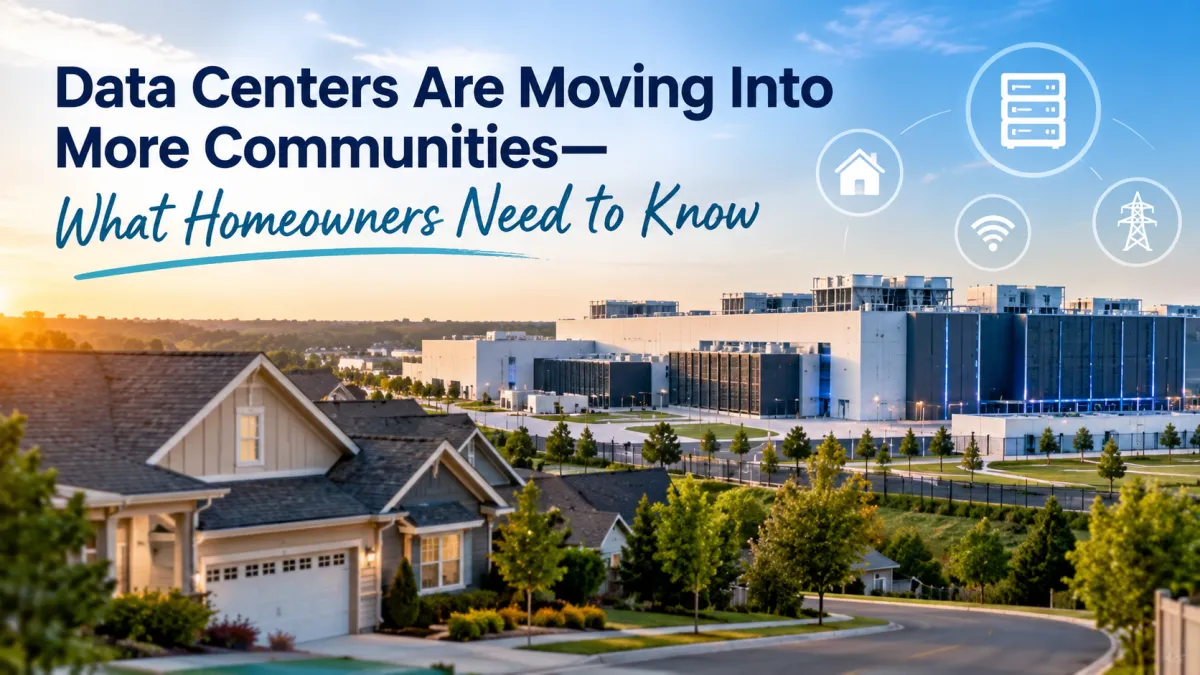
When people evaluate a home, they usually pay attention to familiar factors such as the neighborhood, schools, commute times, nearby services, and proximity to relatives or friends.
The presence of a data center nearby is not something most buyers traditionally think about.
That is starting to change.
As more data centers are built across the United States, homeowners and prospective buyers are becoming increasingly interested in how these facilities could influence the communities around them. Concerns often include home values, utility expenses, traffic, noise, infrastructure changes, and additional development in the future.
The effect of a data center cannot be described as universally positive or negative. Its influence on a neighborhood depends heavily on the individual location, the distance between the facility and residential properties, and the way the surrounding community develops over time.
Data Centers Are Appearing in More Areas
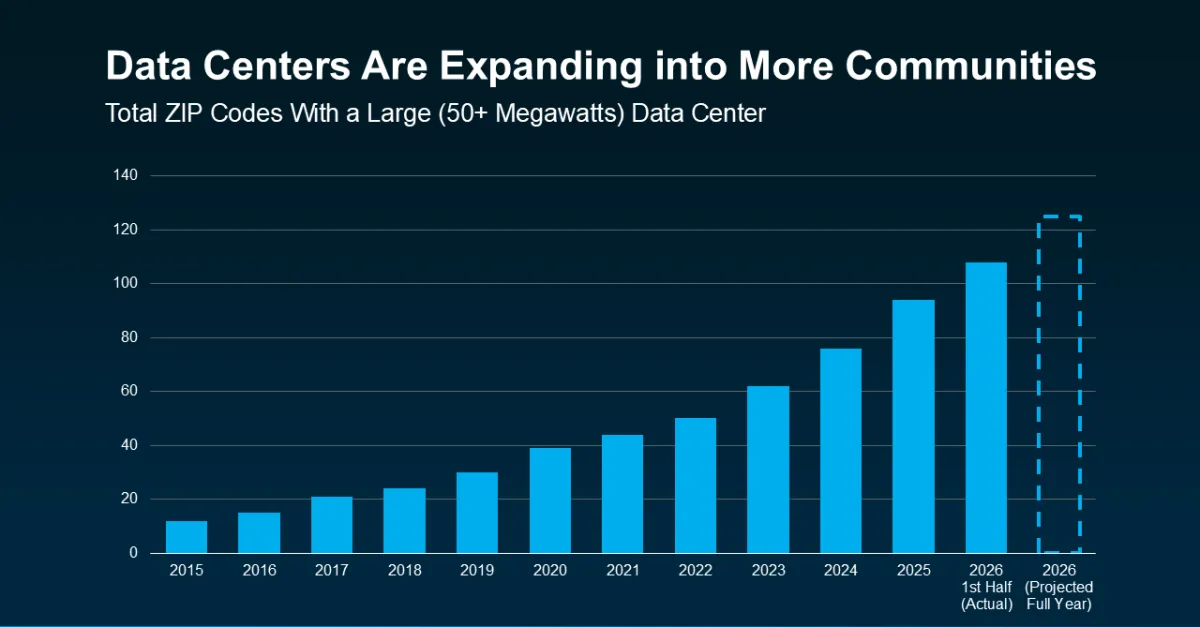
The number of large data center developments has grown rapidly during the past decade.
A decade ago, major facilities were concentrated in a relatively small number of markets and ZIP codes. By 2026, data centers had become far more geographically widespread, with additional projects being proposed and constructed to meet rising demand for cloud services, online platforms, artificial intelligence, and other digital technologies.
As a result, buyers are increasingly likely to encounter homes located near an operating data center or an area where one is planned.
Existing homeowners may also see proposals for related infrastructure, including electrical substations, high-voltage transmission lines, road improvements, and expanded utility networks.
Whenever a project of this size enters a community, residents naturally want to understand how it could affect everyday living conditions as well as the long-term value of their homes.
What Could a Data Center Mean for Property Values?
Homeowners are often most concerned about the possible effect on property values.
However, the presence of a nearby data center does not necessarily lead to lower home prices.
Studies examining housing markets around large data center developments have suggested that properties in those areas can continue to follow market patterns similar to comparable communities without major data center facilities.
Still, those findings do not mean every home will be affected in the same way.
Distance can make a significant difference. A property that directly borders a major facility may be viewed differently from one located several miles away. Buyers may also consider factors such as visible industrial buildings, traffic levels, construction activity, equipment noise, transmission lines, substations, and the likelihood of future expansion.
For that reason, it is more useful to examine the conditions surrounding a particular property than to assume that every home near a data center will experience the same outcome.
Data Centers Can Also Create Local Advantages
Data centers are large investments, and their development can bring financial and infrastructure benefits to some communities.
Because these facilities can represent substantial taxable property, they may generate considerable revenue for local governments. Depending on the local tax structure, that revenue can help support public services, infrastructure improvements, schools, or other community priorities.
Building a data center may also require upgrades to local roads, electrical networks, telecommunications systems, fiber infrastructure, and other utilities.
In some locations, this investment can become part of a larger pattern of economic development. Improved infrastructure and increased commercial activity may encourage additional businesses to locate in the area.
That broader growth can support employment, create opportunities for nearby businesses, and potentially contribute to housing demand.
For homeowners, therefore, the arrival of a data center may need to be considered within the larger context of how the surrounding area is changing.
Potential Drawbacks Should Be Considered Too
Large developments can also introduce challenges for nearby residents.
Data centers often occupy substantial parcels of land and may include large buildings, security fencing, electrical equipment, and other infrastructure. Depending on the location, these features can change the appearance and overall feel of the surrounding area.
Noise is another potential concern. Construction activity, delivery trucks, cooling equipment, mechanical systems, and emergency generators can all contribute to additional sound.
Supporting infrastructure may also affect nearby neighborhoods. New substations, power lines, utility corridors, and road projects can become more visible as data center development expands.
Energy and water consumption are additional issues that communities may consider.
Data centers require significant amounts of electricity to operate, while some facilities also use large volumes of water for cooling purposes.
This does not mean that nearby residents will automatically experience higher utility bills. The effect on household costs depends on many factors, including local utility policies, rate structures, infrastructure investments, development agreements, and how expenses are distributed among residential and commercial customers.
What Buyers Should Research Before Purchasing Nearby
Anyone considering a home near an existing or proposed data center may want to conduct additional research before deciding whether to purchase the property.
One of the first steps is to determine exactly where the facility is located in relation to the home. Buyers should also investigate whether the current site is expected to expand or whether additional facilities are planned nearby.
Visiting the area more than once can also provide useful insight.
Different times of day may reveal changes in traffic, construction activity, or noise that are not obvious during a single visit. Buyers should also consider how visible the facility and its supporting infrastructure are from the home and surrounding streets.
Local government records can provide additional information. Zoning applications, planning commission documents, development proposals, road projects, utility improvements, and construction permits may offer clues about how the area could change in the future.
Looking at all of these factors together can provide a more realistic picture of both current living conditions and possible future development.
What Sellers Should Know About Marketing a Nearby Property
Homeowners selling a property near a data center should not automatically conclude that the facility will reduce buyer interest or lower the home's value.
Some buyers may raise questions about the development, while others may not consider it a major concern.
Having accurate information available can make those conversations easier.
Sellers may benefit from understanding how far the property is from the facility, whether construction is ongoing, whether future expansion has been announced, and whether traffic or noise conditions have changed since the facility opened.
It is also important to compare the property with similar homes in the same local market.
Recent sales activity, buyer demand, time on market, and pricing trends in nearby neighborhoods may provide a much clearer indication of the property's market position than general assumptions about data centers.
Focus on What Is Happening in the Local Market
Real estate conditions can differ dramatically from one community to another.
For that reason, national headlines about data centers and housing prices may not accurately describe what is happening around a specific property.
If a data center is operating nearby or a new project has been proposed, homeowners and buyers should focus on local conditions.
Important questions include how close the facility is to residential areas, whether additional buildings are planned, what infrastructure projects are underway, and whether residents have experienced noticeable changes in traffic, noise, or the appearance of the neighborhood.
Local housing data can also be useful. Examining recent sales, pricing trends, buyer demand, and comparable properties can help show whether the market is responding differently to homes near the development.
These property-specific and neighborhood-specific details are usually more informative than broad claims about the effect of data centers in general.
Bottom Line
Data centers are becoming increasingly common in communities across the country, making them a factor that more homeowners and buyers may need to consider.
Their presence alone, however, does not determine whether a neighborhood will remain desirable or whether a particular property will increase or decrease in value.
The potential effect depends on several local factors, including the home's proximity to the facility, the size and visibility of the development, planned expansion, infrastructure changes, and how buyers respond within that particular housing market.
For anyone living near a data center—or considering a home close to a proposed project—the best approach is to look closely at local development plans, neighborhood conditions, and actual real estate market activity.
That information can provide a much more accurate understanding of what the development could mean for the property and for future buying or selling decisions.
Get In Touch
(951) 202-2303
2514 S. Hacienda Blvd. Ste. A
Hacienda Heights, Ca 91745
Meet Your Agent

Anthony Solomon