Talk To Anthony - Call (951) 202-2303

August 2026 Real Estate Outlook: 5 Numbers Buyers & Sellers Should Watch

The housing market isn't moving in just one direction.
Home prices, inventory, mortgage rates, buyer demand, and negotiation power are all shaping the market in different ways. And while national headlines can provide context, the numbers in your local market may tell a very different story.
So, if you're considering buying, selling, or waiting until later this year, what should you actually be watching?
Here are five numbers that could help put the August 2026 housing market into perspective.
📊 5 Numbers Shaping the 2026 Housing Market
Current national forecasts point toward a market that is gradually becoming more balanced, with slower price growth and improving inventory.
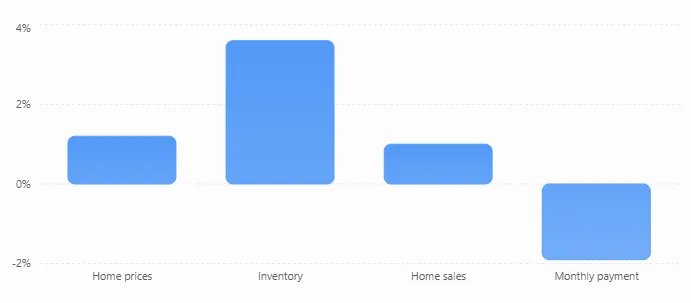
01 — Home-Price Growth
Approximately 1.2% forecast
Home values are still expected to grow, but at a more moderate pace than the rapid appreciation seen in previous years.
What it means: Buyers may not need to expect dramatic price drops, while sellers may need to adjust expectations around appreciation.
02 — For-Sale Inventory
Approximately 3.6% increase forecast
More available homes can give buyers additional choices and reduce some of the pressure created by limited inventory.
What it means: Buyers may have more opportunities to compare properties and negotiate.
03 — Existing-Home Sales
Approximately 1.0% increase forecast
A gradual improvement in sales activity could signal a market where more buyers and sellers are becoming comfortable making a move.
What it means: Activity may be improving without a return to the extreme competition of previous years.
04 — Monthly Mortgage Payment
Approximately 1.9% lower year over year
Even modest changes in borrowing costs can affect affordability when applied to a large mortgage balance.
What it means: Buyers should evaluate the full monthly payment—not simply the interest rate or purchase price.
05 — Local Market Conditions
There isn't one number that applies to every neighborhood.
Your local inventory, median sale price, days on market, price reductions, pending sales, and sale-to-list ratio can provide a much clearer picture of what's happening where you actually want to buy or sell.
The national market sets the backdrop. Your local market tells the story.
🏡 Buyers May Have More Room to Think
As inventory improves in some areas, buyers may have more time to compare homes instead of feeling pressured to make an immediate decision.
That could create opportunities to:
-> Compare multiple properties
-> Negotiate price and terms
-> Request seller concessions
-> Evaluate needed repairs
-> Review the total monthly cost
-> Walk away from a home that doesn't fit the numbers
But more choices don't necessarily mean you should wait indefinitely.
Instead of asking:
“Will home prices fall?”
Ask:
“Does this home, this payment, and this location make sense for me?”
💰 Affordability Still Comes Down to the Monthly Number
A home's price is only one part of the financial picture.
When evaluating affordability, consider:
Principal + Interest + Taxes + Insurance + HOA + Maintenance
And remember:
Qualifying for a payment doesn't automatically mean you should take on that payment.
Your comfortable monthly budget should help determine your price range—not the maximum amount a lender says you can borrow.
🏠 Sellers: Buyers Have More Choices
When buyers have more properties to choose from, sellers need to give them a reason to choose theirs.
Three areas become especially important:
Pricing
Look at current comparable sales, competing listings, and local buyer demand—not just what a nearby home sold for months ago.
Presentation
Repairs, decluttering, staging, curb appeal, and professional photography can help a property stand out.
Marketing
A listing needs more than exposure. It needs a strategy designed to reach the right buyers and communicate the property's value.
Your home's first showing often happens online.
Make that first impression count.
📍 National Trends Don't Tell the Whole Story
Two neighborhoods just a few miles apart can experience very different market conditions.
Before making a major real estate decision, look at the numbers specific to your area:
-> Median sale price
-> Active inventory
-> Days on market
-> Price reductions
-> Pending sales
-> Sale-to-list ratio
These indicators can reveal whether your market is becoming more competitive, more balanced, or more favorable to buyers or sellers.
Don't make a local decision using only a national headline.
🍂 August Is a Planning Month
August sits between the peak of summer and the beginning of fall—which makes it a useful time to evaluate your options before the end of the year.
If you're thinking about selling:
→ Review your home's current value
→ Estimate your potential equity
→ Identify repairs or improvements
→ Study competing listings
→ Build a realistic selling strategy
If you're thinking about buying:
→ Review your financing options
→ Establish a comfortable monthly budget
→ Get pre-approved
→ Monitor inventory
→ Track pricing and price reductions
The goal isn't to predict the market perfectly. It's to be prepared when the right opportunity appears.
🔥 The August Takeaway
The 2026 housing market isn't simply “hot” or “cold.”
It's becoming more nuanced.
Prices are still moving.
Inventory is improving.
Buyer choices may be increasing.
Mortgage costs still matter.
And local conditions can vary significantly.
That means your next move shouldn't be based on a prediction alone.
It should be based on:
**Your numbers.
Your local market.
Your goals.**
🏡 Considering a Move Before the End of 2026?
You don't have to make a decision today.
But if buying or selling is on your radar, August can be a smart time to start gathering information, reviewing your options, and understanding what the current market could mean for you.
Don't just follow the headlines. Understand the numbers behind them.
📩 Reach out today to start the conversation.
Your next move deserves a strategy—not a guess.
💭 Final Thought
The market may never feel perfectly predictable.
That's why the goal isn't to find the perfect moment.
It's to understand your options well enough to recognize the right opportunity when it comes along.
This August, know your numbers, study your local market, and make decisions based on your goals—not the noise surrounding the market.
You don't have to time the market perfectly. You just need to be ready for your moment.
Market conditions vary by location, property type, and price range. National statistics provide broad context and should not be interpreted as a prediction for any specific neighborhood. Buyers and sellers should review current local market data and consult appropriate real estate and lending professionals before making financial decisions.
Get In Touch
(951) 202-2303
2514 S. Hacienda Blvd. Ste. A
Hacienda Heights, Ca 91745
Meet Your Agent

Anthony Solomon